IWC Blog 2011Tweets
Plenary opens w UK reform document being presented. This doc supported by entire 27 member EU and USA, Latin America et al
Main issue is requirement that payment of dues be made by wire transfer only. This designed to prevent vote buying corruption.
Left out of reform is expansion of NGO speaking rights, which are far below what prevails in other international fora.
USA delegation chief "disappointed" expanded NGO participation eliminated. Ms Medina also supported financial reforms.
Sandra Bessudo of Colombia spoke in favor of reforms. Brazil and all Latin American nations emerging as strong 4 the whales.
Nevis-St Kitts put on a comical show badgering minute point after minute point to delay proceedings. Lunch Break til 330p.
Why do certain Caribbean nations attempt to prevent passage of regulations that prohibit cash transactions? Answer is: You got it.
All parties committing to adopt UK reforms by consensus. Japan, USA, St. Kitts-Nevis, UK. Main reform is payment be by wire.
UK reforms adopted by consensus. What's missing is allowing added input from civil society or NGOs which have vast expertise.
Session began more than 1/2 hour late. Japan has introduced measure calling it safety on the high seas but aimed at Sea Shepherd.
Brazil offering proposal for South Atlantic whale sanctuary.
Costa Rica speaking in support of sanctuary - also Colombia, USA , Australia.
Ecuador supports sanctuary. UK supports. Remember passage requires 3/4 majority.
India proposes a name change to this organization to “International Whales Commission”. GO INDIA
Russia asking Brazil and Argentia to withdraw sanctuary proposal to save IWC from self destruction. Huh? So voting would destroy the organization??
Iceland opposes but Denmark says it will vote 4 sanctuary. Israel supports. Monaco too. Switzerland wants 2 put vote off
Nevis (surprise) opposes. Calls sanctuary emotional and calls for more study. Portugal and Spain support sanctuary.
Argentina NGO speaking in favor of sanctuary - one of the rare cases where NGOs allowed to speak.
India states indigenous whaling goal should be to reduce quotas systematically & take into account alternative “food resources”. India putting forth great ideas at this IWC.
Big question is if Latin Americans will demand a vote. Facing this conundrum chair, w Brazil assent adjourned 4 coffee.
Back in session. During coffee only 5 nations opposed sanctuary. Russia opposed but said they would favor vote.
There is no consensus. Brazil speaking now. Delegate says no other way but to vote. Latin Americans will not get trampled as they have in past years.
Argentina asks Iceland, St Kitts, Cameroon, Norway 2 respect will of vast majority + agree to consensus on S Atlantic Whale Sanctuary.
Japan threatens to “break quorum” if a vote is brought on the South Atlantic Whale Sanctuary.
Breaking quorum wud be outrageous and block vote on the sanctuary. This again shows the despicable nature of Japans whalers.
Ecuador says breaking quorum wud end this years IWC.
Colombia speaking with energy and anger against machinations to defeat ability to vote.
Monaco says breaking quorum to defeat a vote would be a disgrace on the IWC. USA silent on this.
Chairman asks for a vote. Nations opposed to sanctuary walking out of room. Will it break quorum?
Japan leads walk out from the IWC meeting in Isle of Jersey. Broke quorum to avoid vote on sanctuary proposed by Latin Americans
After hours discussing whether 2 vote or not on S American proposal 4 a whale sanctuary we are told we must wait another 90 min
Awaiting return of delegates with the text that'll spell out how IWC will proceed on S Atlantic whale sanctuary.
How can St Vincent and Nevis-St Kitts betray their tourist industry by selling out the whales beloved by tourists. Answer has to do with those suitcases of money that have just been banned.
Commission decided to kick the can down the road and have an intersessional meeting to determine rules governing quorums.
Next IWC to be held in Panama. 2012. South Atlantic Whale Sanctuary will be first item on agenda.
IWC is a totally dysfunctional organization. It has 85 member nations, many of which do not attend the meetings or pay their dues. But a quorum is still based on 85 members, so it takes only a small group to break quorum. Reforms are desperately needed.
Wednesday, July 20, 2011


Sunday, July 10, 2011
International Whaling Commission 2011 Sunday 7/10
IWC Blog
IWC 2011 – Why BlueVoice is Here.
The International Whaling Commission is where the fate of thousands of whales will be decided. There are many interests atending vying to determine the policies that will prevail here. The IWC is taking place on the Isle of Jersey, a “separate possession of the Crown”, not part of the UK. Only 12 miles from France.
There are Inuit from Alaska and Greenland, whalers from Japan, members of Sea Shepherd Conservation Society (though they are not allowed in the meeting venue), pro-whale groups of all stripes and delegates from scores of nations.
The message Blue Voice will deliver is that whales are not for killing – not only because they are endangered, though this is true – but because they are sentient, intelligent, magnificent and both curious and friendly to humankind. We have brought films and research papers to prove that point. You wouldn’t need to prove it to anyone who’d ever been in the water with a whale. Those who have done so know it intuitively. But most people, and it’s probably just as well, have never had that direct contact.
Many of the pro-whale groups base their arguments on science and that is vitally important and effective. But most seem to shy away from saying “we should not kill whales on moral grounds.” That is the very message we will emphasize.
Our new film Singing Whales Under the Gun is at
http://bluevoice.org/webfilms_singingwhales.php
BV board member arrived at the venue hotel in the same cab as U.S Chief of Delegation Monica Medina. He was able to give her a copy of our new film which demands the withdrawal of the quota to Greenland for hunting humpback whales.
First meeting of U.S. Delegation and NGOs (non-Governmental Organizations) took place Sunday morning. Very cordial and perhaps a bit promising.
For background information on previous IWC meetings check out The Voice of the Dolphins, available on Amazon.com in print and Kindle format.
IWC 2011 – Why BlueVoice is Here.
The International Whaling Commission is where the fate of thousands of whales will be decided. There are many interests atending vying to determine the policies that will prevail here. The IWC is taking place on the Isle of Jersey, a “separate possession of the Crown”, not part of the UK. Only 12 miles from France.
There are Inuit from Alaska and Greenland, whalers from Japan, members of Sea Shepherd Conservation Society (though they are not allowed in the meeting venue), pro-whale groups of all stripes and delegates from scores of nations.
The message Blue Voice will deliver is that whales are not for killing – not only because they are endangered, though this is true – but because they are sentient, intelligent, magnificent and both curious and friendly to humankind. We have brought films and research papers to prove that point. You wouldn’t need to prove it to anyone who’d ever been in the water with a whale. Those who have done so know it intuitively. But most people, and it’s probably just as well, have never had that direct contact.
Many of the pro-whale groups base their arguments on science and that is vitally important and effective. But most seem to shy away from saying “we should not kill whales on moral grounds.” That is the very message we will emphasize.
Our new film Singing Whales Under the Gun is at
http://bluevoice.org/webfilms_singingwhales.php
BV board member arrived at the venue hotel in the same cab as U.S Chief of Delegation Monica Medina. He was able to give her a copy of our new film which demands the withdrawal of the quota to Greenland for hunting humpback whales.
First meeting of U.S. Delegation and NGOs (non-Governmental Organizations) took place Sunday morning. Very cordial and perhaps a bit promising.
For background information on previous IWC meetings check out The Voice of the Dolphins, available on Amazon.com in print and Kindle format.
Wednesday, July 6, 2011
Evidence of Humpback Whale Intelligence and Culture

BlueVoice Press Release for IWC 2011
Contact: Hardy Jones – hardyjones@bluevoice.org
During the IWC: Hotel de France +44 1534 614000
NEW DISCOVERIES IN WHALE INTELLIGENCE
The official opinion posted on the Japan Whaling Association website is that whales are no more intelligent or special than cows. That is beyond a falsehood. It is an absurdity; but an absurdity based on self-interest.
THE TRUTH: Whales are now documented to share the same kind of intelligence possessed by humans, according to researchers after discovering brain cells in humpback whales previously found only in humans, other primates and elephants.(4)
Recent studies have found a certain type of neuron cell in humpback whales thought to be involved in higher mental processes. These brain structures were previously believed to be the thing that made humans unique in the animal kingdom based on the fact that they’re involved with the processes of emotion and social interaction. These cells occur in parts of the human brain thought to be responsible for social organization, empathy, speech, and intuition about the feelings of others.
These so-called spindle cells are credited with allowing us to feel love and to suffer emotionally. To repeat, they were touted as the brain cells that set humans and the other great apes apart from all other mammals with the possible exception of elephants. Now it has been discovered that several species of whale also have spindle neurons.
Humpbacks, other whales and dolphins exhibit complex social patterns that include intricate communication skills, coalition-formation, cooperation and cultural transmission of information.
The cells, known as spindle neurons, are found in two very restricted regions in the brains of hominids - the family of species comprising humans and other great apes – the anterior cingulated cortex (ACC) and the fronto-insular cortex (FI). Recently they have been discovered in the dorsolateral prefrontal cortex of human as well.(1) Spindle cells are also found in the brains of humpback whales, fin whales, killer whales, sperm whales(2)(3), bottlenose dolphins, Risso’s dolphins, beluga whales, and African and Asian Elephants(5).
These discoveries raise profound questions on the ethics of hunting such sentient creatures.
Examples Of Culture In Whales(6)
Within a given humpback population, male whales (only the males sing) adopt the same mating song, with only minor variations. These songs can be enormously complex, made up of numerous themes that are repeated in the same order. From 1998 to 2008, the researchers identified 11 distinct songs.
“Humpback whale song is unique because intense conformism to the current (song) norm is coupled with high plasticity in the trait,” the authors write.
Male humpback whales (Megaptera novaeangliae) have a highly stereotyped, repetitive, and progressively evolving vocal sexual display or “song” that functions in sexual selection (through mate attraction and/or male social sorting). All males within a population conform to the current version of the display (song type), and similarities may exist among the songs of populations within an ocean basin. Here we present a striking pattern of horizontal transmission: multiple song types spread rapidly and repeatedly in a unidirectional manner, like cultural ripples, eastward through the populations in the western and central South Pacific over an 11-year period. This is the first documentation of a repeated, dynamic cultural change occurring across multiple populations at such a large geographic scale.
The information in this paper is drawn from the sources cited below and is used under The Fair Use Act.
(1) Fajardo et. al.; Escobar, M.I.; Buriticá, E.; Arteaga, G.; Umbarila, J.; Casanova, M.F.; Pimienta, H. (4 March 2008). "Von Economo neurons are present in the dorsolateral (dysgranular) prefrontal cortex of humans." Neuroscience Letters 435 (3): 215–218
(2) Coghlan, A. (27 November 2006). “Whales boast the brain cells that make us human.” New Scientist.
(3) Hof, P. R., Van der Gucht, E. (Jan 2007). "Structure of the cerebral cortex of the humpback whale, Megaptera novaeangliae (Cetacea, Mysticeti, Balaenopteridae)". Anat Rec (Hoboken) 290 (1): 1–31.
(4)Butti C, Sherwood CC, Hakeem AY, Allman JM, Hof PR (July 2009). "Total number and volume of Von Economo neurons in the cerebral cortex of cetaceans.". The Journal of comparative neurology 515 (2): 243–59. (5) Hakeem, A. Y.; Sherwood, C. C.; Bonar, C. J.; Butti, C.; Hof, P. R.; Allman, J. M. (2009). "Von Economo neurons in the elephant brain". The Anatomical Record (Hoboken) 292 (2): 242–8. (6)Dynamic Horizontal Cultural Transmission of Humpback Whale Song at the Ocean Basin Scale,Ellen C. Garland, Michael J. Noad, Anne W. Goldizen, and seven other authors, Current Biology (April 26, 2011)
General References
Nimchinsky EA, Gilissen E, Allman JM, Perl DP, Erwin JM, Hof PR (Apr 1999). “A neuronal morphologic type unique to humans and great apes. Proc Natl Acad Sci USA. 96 (9): 5268–73.
Allman J, Hakeem A, Watson K (Aug 2002). “Two phylogenic specializations in the human brain. Neuroscientist 8 (4): 335–46.
Monday, May 16, 2011
Dolphins Rescue Me From Hammerhead Shark
by Hardy Jones
The following is an excerpt from my just published book The Voice of the Dolphins:
Perhaps the most compelling evidence of how the dolphins felt about us came in 1985 late in the afternoon after a day of filming. Howard Hall, Julia, and other members of the underwater crew had climbed aboard the Zodiak that covered us as we worked at any distance from the main boat. I lingered at the surface, enjoying the delirious late afternoon light, my camera hanging in my right hand. The blue skies above held huge, gleaming white cumulous clouds, and toward the western horizon, blazing orange rays of sunlight shone out of the sea. The water temperature was in the high eighties. I lay on my back and experienced bliss.
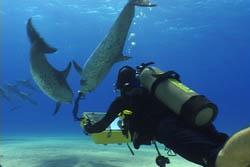
Half a dozen young spotted dolphins, including a band of juveniles we’d named the Gang of Four, swam slowly over the sandy bottom thirty feet below. Occasionally, one dolphin would bite another on the tail and begin a brief, friendly tussle consisting of darting, twisting, and jaw snapping. But mostly they were grazing for bottom fish.
In the distance, at the limit of visibility, another sleek, gray creature appeared, swimming in an unusual, sine-wave manner and hugging the bottom. Its tail was not stroking up and down; it was slashing from side to side. The tail fin was vertical, and the head broad and flat. This wasn’t a dolphin. It was a very large Atlantic hammerhead shark, one of the few shark species that will attack humans. The shark moved toward me, angling first to one side then the other as though following a scent, probably mine. It was swinging its eyeballs, stuck out on the extremities of the head, so as to see its target first with one eye, then the other, perhaps to gauge distance. I didn’t feel comfortable presenting the hammerhead with the sight of my dangling legs, so I jackknifed and dove toward the bottom, raising my camera. Not only was this a unique chance to document the behavior of dolphins around sharks but raising the camera also served to put some metal between the fast-approaching predator and me.
The shark was grayish brown and about eleven feet long. I could judge its size easily because it was twice the length of the subadult dolphins swimming nearby. It undulated across the bottom, its movements now excited and menacing. I’d been diving with hammerheads in the Pacific on numerous occasions and had never felt threatened, but Atlantic hammerheads have a nasty reputation, and this one displayed the agonistic postures that precede an attack.
I hung in the water five feet over the bottom, and sooner than usual, my lungs began to ache for air. In a moment, I’d have to return to the surface. The shark turned directly toward me and accelerated with a flick of its tail. It happened so quickly that I could only react by pulling my camera tight against my body, poised to thrust it against the shark’s sensitive rostrum if it struck at me. I turned the camera on.
Suddenly the undersea world came alive with high-pitched whistles and intense sonar bursts. Two juvenile dolphins, Chopper and Stubby, appeared over my left shoulder. I flinched as I felt the wash they created streaking through the water straight for the hammerhead. In an instant, two buddies joined them, bolting in from the right.
The Gang of Four worked as a unit, diving and turning in unison like a squadron of fighter planes flying precision maneuvers.
The hammerhead saw the onrushing dolphins and, looking harassed and perplexed, jerked to the side, away from me. With powerful beats of their tail flukes, the dolphins launched themselves toward the shark’s head, clicking and whistling intensely, turning away only at the last instant. Again and again the juvenile dolphins dived at the hammerhead, mobbing it the way sparrows do a hawk, using sonar bursts to attack the shark’s lateral lines, a highly sensitive component of the shark sensory system, disorienting the huge fish.
For more stories of interspecies contacts in many oceans of the world read The Voice of the Dolphins by Hardy Jones, available in print and Kindle at Amazon.com
My book is available at my eStore:
http://www.createspace.com/3501299
and at Amazon: http://amzn.to/klnDw0
The following is an excerpt from my just published book The Voice of the Dolphins:
Perhaps the most compelling evidence of how the dolphins felt about us came in 1985 late in the afternoon after a day of filming. Howard Hall, Julia, and other members of the underwater crew had climbed aboard the Zodiak that covered us as we worked at any distance from the main boat. I lingered at the surface, enjoying the delirious late afternoon light, my camera hanging in my right hand. The blue skies above held huge, gleaming white cumulous clouds, and toward the western horizon, blazing orange rays of sunlight shone out of the sea. The water temperature was in the high eighties. I lay on my back and experienced bliss.
Half a dozen young spotted dolphins, including a band of juveniles we’d named the Gang of Four, swam slowly over the sandy bottom thirty feet below. Occasionally, one dolphin would bite another on the tail and begin a brief, friendly tussle consisting of darting, twisting, and jaw snapping. But mostly they were grazing for bottom fish.
In the distance, at the limit of visibility, another sleek, gray creature appeared, swimming in an unusual, sine-wave manner and hugging the bottom. Its tail was not stroking up and down; it was slashing from side to side. The tail fin was vertical, and the head broad and flat. This wasn’t a dolphin. It was a very large Atlantic hammerhead shark, one of the few shark species that will attack humans. The shark moved toward me, angling first to one side then the other as though following a scent, probably mine. It was swinging its eyeballs, stuck out on the extremities of the head, so as to see its target first with one eye, then the other, perhaps to gauge distance. I didn’t feel comfortable presenting the hammerhead with the sight of my dangling legs, so I jackknifed and dove toward the bottom, raising my camera. Not only was this a unique chance to document the behavior of dolphins around sharks but raising the camera also served to put some metal between the fast-approaching predator and me.
The shark was grayish brown and about eleven feet long. I could judge its size easily because it was twice the length of the subadult dolphins swimming nearby. It undulated across the bottom, its movements now excited and menacing. I’d been diving with hammerheads in the Pacific on numerous occasions and had never felt threatened, but Atlantic hammerheads have a nasty reputation, and this one displayed the agonistic postures that precede an attack.
I hung in the water five feet over the bottom, and sooner than usual, my lungs began to ache for air. In a moment, I’d have to return to the surface. The shark turned directly toward me and accelerated with a flick of its tail. It happened so quickly that I could only react by pulling my camera tight against my body, poised to thrust it against the shark’s sensitive rostrum if it struck at me. I turned the camera on.
Suddenly the undersea world came alive with high-pitched whistles and intense sonar bursts. Two juvenile dolphins, Chopper and Stubby, appeared over my left shoulder. I flinched as I felt the wash they created streaking through the water straight for the hammerhead. In an instant, two buddies joined them, bolting in from the right.
The Gang of Four worked as a unit, diving and turning in unison like a squadron of fighter planes flying precision maneuvers.
The hammerhead saw the onrushing dolphins and, looking harassed and perplexed, jerked to the side, away from me. With powerful beats of their tail flukes, the dolphins launched themselves toward the shark’s head, clicking and whistling intensely, turning away only at the last instant. Again and again the juvenile dolphins dived at the hammerhead, mobbing it the way sparrows do a hawk, using sonar bursts to attack the shark’s lateral lines, a highly sensitive component of the shark sensory system, disorienting the huge fish.
For more stories of interspecies contacts in many oceans of the world read The Voice of the Dolphins by Hardy Jones, available in print and Kindle at Amazon.com
My book is available at my eStore:
http://www.createspace.com/3501299
and at Amazon: http://amzn.to/klnDw0
Friday, April 22, 2011
My Diagnosis of Mercury Poisoning from Fish
In the mid-1990s, I had started to experience fatigue. I’d always
tended to work myself to exhaustion but would usually recover
after a night of rest. But by 1997, I was waking up as tired as
when I’d collapsed into bed the night before. I also noticed that
my hands were shaking and my short-term memory was spotty.
I saw a number of doctors and tried to describe my symptoms
in detail. None of them was much interested in what I
had to say. None of them found anything wrong with me. One
suggested the problem was psychosomatic. Then, on advice of
a friend, I went to a chiropractor, Dr. Bob Culver in Los Altos,
California. He was attentive as I described exactly how I experienced
the fatigue, and suggested I submit to a hair analysis that
would determine my levels of salts and heavy metals.
The results of the test were unexpected and alarming. I was
high in cadmium and zinc, but my mercury level was literally
off the charts, and he diagnosed me with “chronic mercury
poisoning”. Where on earth had I accumulated such toxic levels
of this particular heavy metal?
There are two ways to get rid of mercury. One is to simply
stop eating fish that contain high concentrations. The half-life
of methyl mercury is 49 to 164 days so within six months 50 to
75 percent of the mercury will have been eliminated from the
human body, though this rate of dissipation may not be true for
the brain. I stopped eating tuna and swordfish, and my mercury
levels dropped naturally. Another way to speed the mercury on
its way sometimes recommended by doctors is to take zinc
supplements that bind with mercury and eliminate it from the
body in a process called chelation.
I took zinc daily and immediately noticed a huge increase
in my physical strength and mental concentration. When I was
retested nine months later, my mercury level was barely detectable.
I don’t believe I incurred any permanent damage, though
it’s impossible to say for sure. But if high levels of mercury are
ingested by children in early stages of mental and neurological
development, damage can be permanent.
I was relieved to have rid my body of toxic mercury. What
I did not know was that when a fish has a high concentration
of mercury, it almost certainly is high in another class of contaminants:
persistent organic pollutants (POPs) such as polychlorinated
biphenyls (PCBs) and DDT—components of toxic
industrial and agricultural chemicals. There was a time bomb
still ticking inside of me.
The full story appears in my book The Voice of the Dolphins, out very soon.
tended to work myself to exhaustion but would usually recover
after a night of rest. But by 1997, I was waking up as tired as
when I’d collapsed into bed the night before. I also noticed that
my hands were shaking and my short-term memory was spotty.
I saw a number of doctors and tried to describe my symptoms
in detail. None of them was much interested in what I
had to say. None of them found anything wrong with me. One
suggested the problem was psychosomatic. Then, on advice of
a friend, I went to a chiropractor, Dr. Bob Culver in Los Altos,
California. He was attentive as I described exactly how I experienced
the fatigue, and suggested I submit to a hair analysis that
would determine my levels of salts and heavy metals.
The results of the test were unexpected and alarming. I was
high in cadmium and zinc, but my mercury level was literally
off the charts, and he diagnosed me with “chronic mercury
poisoning”. Where on earth had I accumulated such toxic levels
of this particular heavy metal?
There are two ways to get rid of mercury. One is to simply
stop eating fish that contain high concentrations. The half-life
of methyl mercury is 49 to 164 days so within six months 50 to
75 percent of the mercury will have been eliminated from the
human body, though this rate of dissipation may not be true for
the brain. I stopped eating tuna and swordfish, and my mercury
levels dropped naturally. Another way to speed the mercury on
its way sometimes recommended by doctors is to take zinc
supplements that bind with mercury and eliminate it from the
body in a process called chelation.
I took zinc daily and immediately noticed a huge increase
in my physical strength and mental concentration. When I was
retested nine months later, my mercury level was barely detectable.
I don’t believe I incurred any permanent damage, though
it’s impossible to say for sure. But if high levels of mercury are
ingested by children in early stages of mental and neurological
development, damage can be permanent.
I was relieved to have rid my body of toxic mercury. What
I did not know was that when a fish has a high concentration
of mercury, it almost certainly is high in another class of contaminants:
persistent organic pollutants (POPs) such as polychlorinated
biphenyls (PCBs) and DDT—components of toxic
industrial and agricultural chemicals. There was a time bomb
still ticking inside of me.
The full story appears in my book The Voice of the Dolphins, out very soon.
Monday, March 7, 2011
Sharing a Bowride with Dolphins

From Hardy Jones
The following is a brief sample of my forthcoming book, The Voice of the Dolphins. First one to tell me who is the true voice of the dolphins gets a free DVD of The Dolphin Defender, our show on NATURE.
The year was 1978 - our first encounter with the spotted dolphins with whom we would maintain contact for more than thirty years.
Dolphins intercepted our course, and took up positions on both sides of the bow, keeping pace with barely a flick of their tail flukes, pushed along like surfers by the pressure wave made by Albury’s forward motion. We cruised for ten minutes and shot two magazines of film, but there were only so many ways to photograph the same action. Then Jack McKenney had an idea: he and I could hang by our arms from the rope off the witch’s cradle under the bowsprit and suspend ourselves in the water to share the bow wave with the dolphins. It might scare them off, or it might be seen as initiation of a game.
With barely a thought that if we lost our grip, we’d be run over and pulled through the ship’s propellers, we lowered ourselves into the glassy waters. The dolphins barely reacted, moving only slightly to the side or ahead of us. After a moment, they settled back into their former positions, including Jack and me in their formations. I was beyond ecstatic. I had passed through the looking glass and entered a parallel universe.
Two dolphins swam just in front of me, mottled shadows two feet under water. Another surfaced and blew just an arm’s length to my right. The warm, salty Bahamian waters lifted us, and the pull of the boat allowed us to skim along the surface. My arms felt strong. The sun made the world warm with golden light. I wanted to freeze or distill this moment to somehow hold on to it.
I stuck my head underwater and rolled to the side. The dolphins became excited and barraged me with sonar. A youngster bolted in from the stern wake and nearly touched me before its mother called it away. More dolphins arrived, and now it was clear we had reached the middle of their territory, so Mike slowed the boat and Ray dropped anchor. The dolphins lingered and began to play among themselves only a few feet from Albury. My own private moments with the dolphins came to an end as the rest of our crew jumped into the water. Excited, the dolphins responded, pink bellies flashing against the deep turquoise background.
We swam with the dolphins as the sun melted into the horizon. Jack and Jim filmed, but the rest of us sought out individual dolphins. Both dolphins and humans were more relaxed than during first contact. The mood of the encounter reflected the calm clarity of the sea. Perhaps we had gone through the introductory stage of excitement and wonder and could now begin to get to know one another in a calmer mood. We looked the dolphins in the eye, and they looked back. Although it was only a day after our first meeting, it felt like a reunion in the open sea, more than thirty miles from land.
Friday, February 18, 2011
Japan Retreats From Southern Ocean - What's Next

By Hardy Jones, author of forthcoming book The Voice of the Dolphins,
Executive Director BlueVoice.org
Now that Paul Watson and his Sea Shepherds have drive the Japanese whaling fleet from the Southern Ocean to end their whaling season early, the question arises as to what's next for Japanese whaling. Tokyo confirms the whaling fleet has been called home, ending the 2010 - 11 season, but leaves open possibilities of returning to the Antarctic next year.
Of course if Japanese whalers return to the Antarctic seas they will face Watson and his fleet - probably stronger and more imaginative than ever. In addition international law regulating shipping in the Antarctic will mandate, as of August 2011, that machinery using heavy oil be replaced by devices running on light oil. That is not massive expensive but would require a refit of the factory ship Nisshin Maru in times when the bogus scientific whaling operation is not coming close to paying its way through sale of whale meat.
In addition the factory ship is old and dottering. She has had two fires in recent years that, had they gotten out of control, could have unleashed devastating pollution in the sensitive Antarctic ecosystem. Is building another factory ship an option? I don't think so. I was on the Nisshin Maru some years ago when she tied up in Japan. It was like being on an aircraft carrier. There could be no economic incentive for building another of these Goliaths when sales of whale meat are falling and huge unmarketable stockpiles of whale meat are stuffing freezers in Japan.
Japan's bureaucracy is by no means united in support of whaling. The Foreign Ministry and Ministry of Trade and Industry have spoken internally against whaling as something that damages Japan's image and commerce. But Japan's Fisheries Agency is so powerful it has been able to override opposition to whaling. This is the same agency that supports the slaughter of thousands of dolphins in Japan.
The fisheries agency has tried to expand the take of dolphins. Taiji, the town made infamous by the film "The Cove", built an expensive new abattoir in hopes of expanding output of dolphin meat. But interest in dolphin is declining as more people become aware of the levels of mercury and other contaminants in the meat.
Japan also hunts whales in the Northwest Pacific. Likely the Nisshin Maru will depart for these whaling grounds in May. In recent years they've taken Bryde's, sei, sperm and minke whales. This hunt takes place in Japanese territorial waters and would not be accessible to Sea Shepherd action. But there are reasons to question the wisdom of hunting these populations of whales. Sperm whales taken in past years were declared unit for human consumption due to high levels of pollutants in the meat.
An emerging element in the calculus over whaling is the presence of disease antibodies in many marine mammals around the world. Kazue Ohishi of the University of Tokyo and his colleagues discovered pathological and seriological evidence of Brucella infection in baleen whales taken in the Northwestern Pacific. Brucellosis is a disease with proven zoonotic potential. It can spread from one species to another. Workers exposed to contact with animals or meat -- such as slaughterhouse workers, farmers, and veterinarians -- are at high risk of this serious disease. The possibility of transmission of Brucellosis from raw whale or dolphin meat to humans is a very real possibility.
The increase in diseases such as Brucellosis among immune suppressed marine mammals is another sign of the deterioration of the ocean environment. It is a brutal absurdity that whales be hunted in such a circumstance.
Subscribe to:
Posts (Atom)