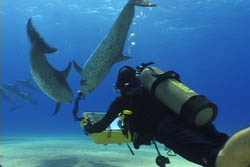
As the day wore on the tide moved up the beach pushing us closer and closer to the dunes. Finally we were driving through the surf and I felt that we had accomplished our mission. We had counted 615 dead dolphins and had evidence of the tragedy and necropsy samples that might shed light on what had produced this catastrophe.
We found an opening in the dunes and headed east toward the Pan American Highway. Initially we passed through an area behind the dunes that was flooded when the sea was high enough to crest the dunes. But it was now dry and reasonably hard. We made good time.
Our little fellowship consisted of Carlos and me, a driver, a tall female Dutch student and two female Peruvian members of ORCA-Peru. It was pretty cramped. A dangerous lot if I’ve ever seen one.
We then entered an area of powdery sand blown up into ridges that shaped just like waves. We’d go over the top of a crest then plunge into the trough. Hints of previous traffic were everywhere but no clear road to the Pan Am.
Eventually we found ourselves perched over a vast open pit mine. Massive trucks and earthmovers gouged the earth for phosphate. We made our way down tracks in the desert, occasionally stopping to ask guards in variously colored hard hats for directions. They looked surprised but pointed east.
Eventually we reached a huge conveyer belt and then saw the exit gate, which was open. As we approached it men in various colors of overalls and hard hats came running toward us. The gate was closed in front of us. We were in the land of Dr. No.
They asked for our IDs. Strutted around. Wrote on their clipboards. Carlos laughed saying “They’re so screwed because they’ve allowed a breach in security.” I thought, “They’re nuts to write this down. They should just pass us through and hope no one knows we got through their lines.”
Finally they let us out and we ran back to Chiclayo.
What were they afraid of; that we’d steal their phosphate? Or was there something in the mining process that was running into the sea. There was that one huge pipe running through the desert. The words “something evil this way comes,” ran through my mind.
Showing posts with label BlueVoice. Show all posts
Showing posts with label BlueVoice. Show all posts
Tuesday, April 10, 2012


Tuesday, August 30, 2011
What Will it Take to End Japan Dolphin Slaughter?

By Hardy Jones
This is a slightly modified article I wrote last year for Huffington Post. It reflects the fact that Sea Shepherd pushed the Japanese whaling fleet out of the Antarctic during the 2010-11 season. But the principal issues are the same this year as last.
The dolphin hunt begins at the end of this week. Perhaps 100 police, coast guard and god knows what other form of policing will be present to greet the ever growing crowds of dolphin activists drawn to the scene of the killing.
On September 1st the dolphin hunts in Taiji, Japan are scheduled to resume despite unrelenting tsunamis of publicity around the world highlighting this brutal slaughter. In addition the village of Futo, just southeast of Tokyo, has announced it will resume dolphin hunts, mainly to secure dolphins for captivity. Dolphin hunting in Japan continues uninterrupted. NB: This did not happen last year, primarily due to absence of dolphins from their waters.
The resumption of the dolphin hunts followed a weekend, August 27 - 29, during which Animal Planet aired the two-hour season finale to Whale Wars, the fight by Sea Shepherd to stop whaling by Japan in the Antarctic, a two-hour presentation of The Cove, the academy award winning film by Louis Psoyhos featuring Ric O'Barry; and the premier of O'Barry's own three-part film series Blood Dolphins. This represents a media barrage of unprecedented dimension.
NB: The dolphin hunt continued through the entire 2010-11 season and was even extended.
While issues of cruelty are a highly important part of the argument against these hunts there is another compelling reason why dolphins and whales not only should not be hunted but instead demand greater protection than ever.
Growing evidence suggests that dolphins are becoming so contaminated by marine toxins that eating them constitutes a genuine threat to human health. Health officials in Denmark and the Faroe Islands have already recommended that consumption of pilot whale meat taken in the notorious "grinds" not be eaten due to high levels of contaminants in the meat.
The issue of heavy metal contamination in large predatory fish and marine mammals is becoming well known. Less widely known are the high levels of organic pollutants such as PCBs, PBDEs, DDT, and other chemicals that suppress mammalian immune systems and disrupt normal endocrine function. Some of these chemicals are known to be estrogen imitators that act to feminize men and superfeminize women; in some cases raising the percentage of females babies born over male babies significantly.
Dolphins are already severely threatened by anthropogenic forces. During the last year numerous peer-reviewed scientific papers have been published documenting a worldwide surge in incidence of diseases heretofore unknown in dolphins.
A team of researchers and veterinarians from the Marine Animal Disease Lab at the University of Florida have discovered at least fifty new viruses in dolphins, the majority of which have yet to be reported in any other marine mammal species.
Thirty new diseases have developed simultaneously worldwide resulting from what Dr. Gregory Bossart, Chief Veterinary Officer at the Georgia Aquarium, describes as profound immunosuppression leading to environmental distress syndrome resulting from chemical intoxication.
In addition, resistance to antibiotics has been found in dolphins in numerous locations around the world. Obviously antibiotics do not occur in nature. They come from people who take antibiotics and introduce them into the ecosystem through bodily elimination or simply throwing unused pills away. After they reach the watershed plankton ingest them and they bio-accumulate up the food web to concentrate in top predators such as dolphins. The dolphins then have the potential for breeding antibiotic resistant super bugs that may pass back to humans. The transmission of disease from one species to another is called zoonosis and is of great concern to the CDC. AIDS is one example of zoonotic transmission.
I first went to Japan to stop the dolphin slaughter at Iki Island in 1979. In 1980 cameraman Howard Hall and I filmed a barbaric slaughter of scores of bottlenose dolphins. Airing of the footage around the globe caused massive worldwide protest.
In that case exposure of the brutal footage of dolphins being hacked and stabbed to death essentially brought an end to the dolphin hunt at Iki. But such publicity has not produced a similar result since. NB: Dolphins are no longer found around Iki, This may be the result of changing water temperatures forcing their prey to other parts of the sea or it may be the dolphins around Iki were extinguished by the brutal hunts.
After Paul Watson and his Sea Shepherds vanquished the Japanese whaling fleet from the Southern Ocean Japan may believe it has to dig in its heels on the dolphin issue. The massive deployment of police to Taiji certainly indicates they are not backing down. I have been told by highly knowledgeable Japanese environmentalists that sticking Japan's nose in it may be making it all but impossible for Tokyo to withdraw from dolphin hunting. A proud sovereign nation cannot allow small groups of environmentalists to be seen to make it kow-tow. If Japan stopped dolphin hunting now it would appear environmentalists had forced them to back down. But the knowledge that diseases such as brucellosis and papillomavirus are being found ever more frequently in dolphins may, ironically be what forces the end of eating dolphin meat. And if that isn't enough thirteen additional RNA-based viruses that cause intestinal disease and encephalitis in humans have also recently been discovered in dolphins
It baffles me that whaling and dolphin killing can persist in the 21st century. We know so much about these magnificent animals. Whale and dolphin watching generate over US$2.1 billion per year around the world, vastly more than whale and dolphin killing.
But human self-interest on the part of entrenched bureaucratic elites is a powerful force molding individual ethics and shaping short sighted policies. So in Japan and elsewhere whaling and dolphin hunting persist.
In the light of emerging threats to the marine ecosystem, dolphins and whales in particular, the deliberate killing of these curious, intelligent, sentient animals is tragic and will only hasten the extirpation of whole populations of these magnificent sentinels of the sea.
Friday, August 26, 2011
Eyeball-to-Eyeball with a Sperm Whale pt II
By Hardy Jones
Thoughts floated through my mind, lingering for instants but, finding no certainties on which to perpetuate themselves, drifting back to wherever thoughts come from. "What does the vast computing system housed in the six-foot square skull of this animal make of me? Am I a joke? Does it find me as funny as I might a monkey scratching its ass? Surely it doesn't see me as edible? Does it have any clue that I can think too?"
But the one thought that never left my mind was, "how do I keep this animal with me?" For by now I was in love with this whale. I could not disengage my eyes from its one huge eye. I watched its every move. "Every move you make, every breath you take. . . . .". Even in open ocean swimming with a sperm whale my mind is a jukebox. It breathed every thirty seconds. I huffed and strained for enough air to keep my legs pumping. For five minutes we swam eyeball-to-eyeball, the whale using only the barest motion of its tail to gain forward momentum. I was surely in an altered state but it was not dreamlike. It was intense reality.
The great eye moved slightly forward in its socket, the left edge of the tail fluke was raised and my whale began a right turn, prelude to breaking off contact. You cannot pursue whales. If you try you will find yourself looking at a disappearing tail, some sloughed off epidermis and more than likely passing through a reddish brown cloud. So I resisted that impulse and turned left, mirroring the whale's retreat. When I looked over my shoulder the whale had turned back toward me.
Knowing I had to try to bring it to the camera I headed back towards the boat. Roc, with his huge housing, could not have moved far from it. I resented the responsibility of having to help the French crew get video of this encounter. I wanted my whale to myself to see where the encounter would go if we were left on our own.
As we approached the boat I could see Roc hanging at the surface, the glassy dome of his camera pointing at us. He was getting his video but I was going to lose my whale. Perhaps unwilling to get close to another of these strange creatures or to approach the boat, perhaps obeying a call from its mate far below, the sperm whale breathed twice, accelerated, arched forward and began to swim almost straight down. I could see it pass through the slanting golden shafts penetrating the blue of the sea. A bubble from its blowhole, a bubble from its anus and it was gone.
I don't remember swimming back to the boat but once aboard I jettisoned my dive gear and clenched my fist in triumph. Trying to share some of the experience with the French video crew I said "Incroyable! Ne c'est pas?" The director raised his shoulders and twisted his face performing that characteristic Gallic shrug and lit a cigarette.
To me to be uninspired by a sperm whale is a tragedy. Soon I will write about the joke I played on the French film crew. I love France and the French (by and large) but occasionally their arrogance needs to be brought down a peg.
For more stories of interspecies contacts in many oceans of the world read The Voice of the Dolphins by Hardy Jones, available in print and Kindle at Amazon.com
Sunday, July 10, 2011
International Whaling Commission 2011 Sunday 7/10
IWC Blog
IWC 2011 – Why BlueVoice is Here.
The International Whaling Commission is where the fate of thousands of whales will be decided. There are many interests atending vying to determine the policies that will prevail here. The IWC is taking place on the Isle of Jersey, a “separate possession of the Crown”, not part of the UK. Only 12 miles from France.
There are Inuit from Alaska and Greenland, whalers from Japan, members of Sea Shepherd Conservation Society (though they are not allowed in the meeting venue), pro-whale groups of all stripes and delegates from scores of nations.
The message Blue Voice will deliver is that whales are not for killing – not only because they are endangered, though this is true – but because they are sentient, intelligent, magnificent and both curious and friendly to humankind. We have brought films and research papers to prove that point. You wouldn’t need to prove it to anyone who’d ever been in the water with a whale. Those who have done so know it intuitively. But most people, and it’s probably just as well, have never had that direct contact.
Many of the pro-whale groups base their arguments on science and that is vitally important and effective. But most seem to shy away from saying “we should not kill whales on moral grounds.” That is the very message we will emphasize.
Our new film Singing Whales Under the Gun is at
http://bluevoice.org/webfilms_singingwhales.php
BV board member arrived at the venue hotel in the same cab as U.S Chief of Delegation Monica Medina. He was able to give her a copy of our new film which demands the withdrawal of the quota to Greenland for hunting humpback whales.
First meeting of U.S. Delegation and NGOs (non-Governmental Organizations) took place Sunday morning. Very cordial and perhaps a bit promising.
For background information on previous IWC meetings check out The Voice of the Dolphins, available on Amazon.com in print and Kindle format.
Wednesday, December 22, 2010
Santa Arrives by Sea


By Hardy Jones, executive director BlueVoice.org
Author soon-to-be released book The Voice of the Dolphins
The Christmas season of 2010 brought a day of reunion for the officers and crew of a cruise ship and the sisters and children of a Catholic orphanage on the Caribbean Island of St. Lucia. In late October Hurricane Tomas had slammed into the island interrupting supplies of water, food and transportation. Some Lt. Lucians had had no food or clean water in days. Noordam came to the rescue.
When hurricanes are bearing down on an island destination, the standard mode of operation for cruise ships is to run for calmer waters so passengers will not be disquieted by the tempest and their safety will be ensured. But when Captain John Scott of Holland America’s ms Noordam learned of the serious destruction caused by hurricane Tomas on St. Lucia he made full speed back to the island he had just departed. Tomas destroyed much of the island’s infrastructure. The lack of drinking water was acute.
The situation was particularly dire at the Holy Family Children’s Home, an orphanage that had been adopted by Noordam and its crew. The kids were hungry, thirsty and scared.
On November 7 Noordam delivered some 50 thousand gallons of water to the main dock in Castries for the general population. This was no easy feat as ships are designed to take on water, not dispense it. But the officers and crew jury-rigged a system to deliver the life sustaining water. They also delivered food from the ships larder and clothing. Passengers chipped in with cash donations that went to the orphanage and an old age home.
I spoke with Captain Scott and hotel manager James Deering aboard the Noordam. “It was nice to be able to help people out when they are down,” the captain told me. And Holland America corporate had been totally behind his aid efforts. The ship was preparing to deliver on the requests for gifts made by the orphans to be delivered a couple weeks later.
After I left the ship James Deering wrote me about the special Christmas visit by Noordam in St. Lucia.
Every child from the orphanage received exactly what he/she had wished for from Santa Claus.
The pool party / brunch went over very well.
The teen girls had their first spa treatments.
The kids ate more than seemed humanly possible - and took the leftovers back home with them.
Our generous guests donated approximately US$1,500 cash, which was given directly to the Sisters who run the orphanage.
We sent boxes of christmas cookies and candies home with them as well to cover Christmas Day.
While on St. Lucia my wife Deborah and I were able to negotiate the washed out roads on the island to take an aerial tram through magnificent rain forest. It was encouraging to see many birds had survived the winds and rain. Some tourist activities were not yet operable but progress is being made in restoration. I have to say St. Lucia is one of the lovliest islands in the West Indies.
I guess I should also mention that I have no affiliation with Holland America Cruise Lines.
Monday, December 20, 2010
THE DAY WE SAVED THE DOLPHINS

From the soon-to-be released book The Voice of the Dolphins
by Hardy Jones
In 1980 Howard Hall and I were on our way to Iki, Japan to attempt to stop the slaughter of dolphins there. En route we were diverted.
We woke up our first morning in Osaka and saw a story on the front page of the Japan Times, an English-language paper published in Japan. The story’s headline reported “200 Rare Whales Captured at Taiji.” The animals were melon-headed whales, actually a species of dolphin. The story went on to say that the dolphins would be killed to provide food for lions at the Shirahama Zoo. It struck me as extraordinarily perverse that these magnificent wild dolphins would be killed to feed captive lions.
We changed plans on the spot and headed for Taiji, a small village of some thirty-five hundred people on the coast east of Osaka. We arrived in Taiji, found accommodations in a small hotel, and walked out to the small bay where the pitiful dolphins were being held. The coast there is magnificent with endless bays and coves formed at the juncture of mountains and sea.
Our presence disturbed the fishermen who had driven the dolphins into the bay. They were aware of the international outrage provoked by the slaughter at Iki the year before and didn’t welcome any foreign observers—especially those with cameras.
There wasn’t much Howard and I could do directly, so we just hung around the bay with our still and movie cameras at hand. The fishermen seemed stymied. They held meetings. Two days passed. Some of the dolphins succumbed and sank into the depths of the cove, but most remained alive. Howard and I worried that while the fishermen were talking, the dolphins weren’t eating and might starve. Dolphins do not drink and depend entirely for their hydration on the fish they eat.
On the third day of captivity for the melon-heads, the fishermen informed us that as a gesture of goodwill, the dolphins would be released. I believe they were afraid of attracting the same kind of international outrage that had been focused on Iki. The following morning, the fishermen drew back the net separating the melon-heads from freedom. But the dolphins didn’t budge. Confusion or shock or the knowledge that members of their pod were sick or injured kept the group huddled at the end of the bay farthest from the net.
The fishermen brought a small skiff driven by an outboard motor in behind the dolphins and began revving the engine. The dolphins started to move. The skiff herded them until they were past the net line. Once out of confinement with a clear vision of open ocean ahead, the whole pod erupted into spectacular porpoising leaps across the face of the sea. I remained poker faced, but inside, I was wild with joy. Maybe our cameras were all powerful.But that was long ago.
Saturday, July 17, 2010
Meeting Dolphin Friends

July 10. It’s been thirty 32 years since I first sailed into the world of the spotted dolphins who inhabit the northwestern Bahamas. This year we’re near Bimini, a location I first discovered in 1987 aboard Juliet, a 103-foot schooner with spacious, comfortable staterooms.
We left Miami at 4pm, passing through light rain. Giant black and gray cumulous hovered behind us over the highrises that face on government cut. Two massive cruise ships preceded us, the two carrying roughly three thousand passengers. Quite a contrast with Juliet carrying twelve plus crew of four.
At 2am July 11 we anchored north of Bimini and woke up to dolphins around the boat. There were approximately sixteen spotters, mostly juveniles.
My goal is to get as many identifications as possible of individuals here. Most of my work with dolphins in the Bahamas has been with the pods of the White Sand Ridge, north of Grand Bahama island. In 2004 and 2005 that area was hit by massive cat 5 hurricanes. Many of the dolphins previously identified in that area were not seen after those events. There is a possibility they moved to other areas and Bimini is not far from the northern schools.
It was even thought that Chopper, whom I first identified in 1979 and had known personally for nearly three decades, had been among the victims of the tempests. But Denise Herzing, a dedicated scientist who has studied the White Sand Ridge school, told me she had seen him in 2007. That was a relief.
The dolphins found us about 730 am. They were really engaged with the divers. I shot some nice video. After a midday break of diving and lunch we found dolphins at 4pm. They were playing wildly amongst themselves. They had no interest in us but they did not run from us. I found myself totally enveloped in dolphins during some of my freedives and the video came out nicely. So far we’ve only been able to identify one dolphin from this area – one with a shark bite that tore away half the dorsal fin.
July 12 we found dolphins early but disengaged when they seemed to want to be on their own. The weather is very hot – in the mid 90s and I’m urging everyone to drink water, take salt and keep slathered in sunscreen. Late afternoon we found dolphins feeding. Entered the water and a lone teenager came to a group of 8 of us passing very close to each diver, closing its eyes in a sign of trust. Maybe a smile. Gazed at itself in my camera dome.
July 13. Brilliant scuba dive on a drop off north of Bimini. In afternoon there were four boats looking for dolphins. Not a good scene. We had only minor contacts and I broke off in late afternoon. We will head for another location. It just didn’t feel good to me to see all those boats running around trying to pick up dolphins.
July 14. Dove Bull run. Friends very happy with the reef sharks. Ran to b-2 and found dolphins immediately. Two close encounters with them. One appeared to have been slapped with silver paint three times on right side. Another had deep cut in dorsal starting just forward of the peak. A lovely squall swept over Juliet just after dinner.
July 15. Seas came up over night. Three to four foot swells in the morning. Six playful young dolphins hit our bow after breakfast. One was silver paint. Divers had a phenomenal experience with this group for 45 minutes. Seas layed down.
July 16 Awoke in Miami harbor and said goodbye to the BlueVoice supporters who had accompanied us. Tomorrow a new group joins us and we head back to the Bahamas.
Wednesday, March 24, 2010
Entangled Humpback Location Currently Unknown
Entangled Humpback Location Currently Unknown
I just received a call from Jamieson Smith of National Marine Fisheries Service (NMFS) bringing me up to date on the status of the humpback whale entangled off Florida.
The humpback sighted off Ft. Pierce is the same one first seen off St. Augustine March 7. A concerted effort was made to rescue the whale on that occasion. But the whale has been highly evasive. It evaded placement of a satellite tag that would have enabled continuous monitoring of its position.
NMFS is advertising a hotline number for anyone spotting this entangled whale. 866-755-6622
The rescue team that was in St. Augustine has been moved to Ft. Pierce to be ready should another rescue attempt be possible.
There have been reports of entangled humpbacks off the Florida coast in recent days but the whales turned out to be unencumbered.
There was no calf with the entangled humpback. The captain of the party boat who reported that says he saw a large animal under the entangled whale. He assumed it to be a calf but in retrospect says it never surfaced so the shadowy figure must have been a shark.
We discussed the dolphin activity around the humpback and Jamieson told me that was not unusual. We both agreed that it is hard to impute motivation to dolphins under such circumstances. But he did say that having dolphins around an entangled whale makes it easy to find the whale.
I told him of my experience in the Bahamas where I was certainly protected by four juvenile spotted dolphins from a hammerhead shark. Judge for yourself in the accompanying video.
Wednesday, March 17, 2010
Link Between Dolphin Slaughter and Whaling

By Hardy Jones
When I was in Iki, Japan three years ago the former head of the fishermen’s union told me something important. Iki had not been granted any further quotas to hunt dolphins because the Japan Fisheries Agency (JFA) felt Iki had gained too much notoriety from the footage Howard Hall and I took of the 1980 slaughter.
He said the JFA feared the dolphin slaughters and whaling would be linked in peoples’ minds and that whaling was vastly more important to Japan than the dolphin hunt.
Now I don’t know how this squares with the worldwide ignominy Taiji has suffered from films over the last few years, most recently The Cove and prior to that When Dolphins Cry, a film I did for National Geographic. But I believe the linkage exists.
It is important to see the connection between the two issues. The killing of whales at sea, while it has been filmed by Sea Shepherd and Greenpeace, does not compare in graphic intensity with the ghastly slaughter of dolphins that can be videotaped from the shores of Hatagagiri Bay at Taiji.
The two hunts – for dolphins and whales – meld in the mind. They are rightly seen as a common policy of the nation of Japan. In addition there is the fact that dolphin meat is often sold as whale meat.
Ultimately there is the image of a modern industrial nation countenancing the hideously cruel and primitive killing of animals of high intelligence – animals that are beloved around the world.
Finally there is the perfidy of the Japanese government denying the findings of its own scientists – that dolphin meat and whale meat contain high levels of contaminants that threaten human health.
For those of us who write about these issues keep the linkage in mind. Japan would sacrifice the dolphin hunt to save whaling. And the blood of the dolphins is the blood of the whales in the mind of all who care about both.
Monday, January 11, 2010
Shark finning horror in Japan

by Hardy Jones
Attached to this blog you will find a photo of the catch from a single Japanese shark fishing boat. It will give you an idea of a process that is exterminating sharks worldwide. BV http://www.bluevoice.org is funding a study of mercury levels in sharks as part of an effort to dry up the market for shark products.
Photo by Circlet. Copyright Circlet, BlueVoice.org
More soon.
Monday, November 16, 2009
Baby Boom among San Juan Orcas Killer Whales

BabyBoomOrca
The birth of the fifth killer whale calf this year within the endangered southern resident killer whales pods is spectacular news. The births bring the total number of animals in J, K and L pods to 87.
"It's a baby boom," said Howard Garrett of Orca Network. http://www.orcanetwork.org
But this news is countered by the fact that seven orca of these same groups died over the past winter. There is genuine concern about the survival of these highly beloved whales. The salmon on which these orca feed has been in low supply and the whales that died showed signs of emaciation. They are also some of the most toxic animals on earth, containing huge levels of chemicals such as PCBs.
Historically, the three pods had about 120 members. But that was before dozens of these magnificent animals were cruelly captured for the aquarium trade. In the late 1990s dredging in Puget Sound may have released plumes of toxic sediments that poisoned the animals downstream of the location.
Dr. Ken Balcomb, of the Center for Whale Research, a longtime friend, was one of the researchers who first photographed the newest arrival. I’ve spent joyous times with Ken running with the J, K and L pods. In my film “The Dolphin Defender” Ken describes the crisis these orca face from lack of food and pollution.
The newborn calf has characteristic pink markings and folds behind the dorsal fin. The calf was swimming with Polaris, its mother, a 16-year-old aka J28. See video http://www.youtube.com/watch?v=cIAT-DnD2ek
In my days with Ken he described how female orca offload lipophilic (fat binding) toxic chemicals into their newborns through their lipid rich milk. This reduces the mother’s toxic burden but has always struck me as among the most perverse results of how we treat the oceans as a dump for deadly chemicals. The new arrival will have a better chance of survival because its mother has already had a calf that died. Its death would have allowed Polaris to eliminate toxins such as PCBs and fire retardants from her system, according to Balcomb.
Another source of hope is that this year
has been much better for salmon than last. "I just hope they are well-fed from the summer and don't have to dig too far into their fat reserves. We'll do a roll call when they all come back at the
beginning of next season," Balcomb added.
More information on contaminants in the marine environment dangerous to both killer whales at humans at http://www.bouevoice.org
Monday, November 2, 2009
Booby Traps at Taiji

By Hardy Jones
A very brave young Canadian woman has reported from Taiji that the fishermen have booby trapped the hill from which we video the dolphin slaughters.
Leslie-Ann Gervais is now home in a small town in Ontario. It is very fortunate that she escaped serious injury. Here is what she wrote in an email to me:
“... the booby traps were set up with "razor wire" as the ends that grabbed onto my leg, ankle and shoe were very sharp, still have a few marks...and that was from a very cautious step. They had strung more at a head-high level the next day as well...which could poke out an eye...or worse slice into someone's throat.
“The Dawn of the killing...(which happened while it was still dark)....i counted 16 men in a boat leaving the scene (last time 9-10 men)....maybe they had herded-in more later that day which is why there were more men this time and I may have even missed out on counting others too. And this time, they did the killings in the dark and they took such pains with booby traps and trying to block the look out . . .”
“When i went back again today i could not get through that one area...in fact i got caught up in barb wire even though i was looking for it! It latched on to my pants, ankle and shoe...with just one cautious step. Therefore, since yesterday they have entwined EVEN more barb wire. It is tied around trees and stretches and entwines itself camouflaged within the trees and among bushes and leaves. Yesterday, found one which was ankle high, but tied between two trees... NOW, just now saw one head high...which could easily slice through a neck or take out an eye. Makes it very dangerous for anyone who is filming or taking photos and not paying attention to their surroundings.”
Went to the cove this morning...wanted to be present for this family of Pilot Whales. I arrived just as the dawn was breaking and the slaughter was ending. "Personal Space" was in my shadow, flickering his lighter, moping around me - he was sulky, perhaps because i did not have a camera in his face.
This morning they had three nets, two on the outside and one dividing inside the cove. Perhaps because last time they had a problem with the last brave Samurai Pilot Whale who fought so hard. This family of Pilot Whales seemed to slip away quickly....as there were more men this time ...counted 16 men out there on three boats.... After the slaughter they checked the nets as though they were looking for one that had been killed, but disappeared....and made me think of the baby:(. Just so awful. At the end, a speed boat of 11 men came towards shore - all looking my way...even though i may have been scared inside....showed no fear...and gave them my best Native warrior look, 9 men disembarked and left the scene.”
What an extraordinary young woman, operating alone in Taiji!
Sadly it is clear hunting dolphins at Taiji has not ended. It is now clear to me that the only way to end it is to prove the high toxic levels in marine mammals, in the people who eat them and then connect high toxic levels to disease.
Subscribe to:
Posts (Atom)