A new report indicates a tie between the widely used pesticide Atrazine and obesity and diabetes. Atrazine, according to Mary Turyk et al, affects insulin signaling and induces insulin resistance. The report says "Atrazine or its metabolites might be introduced into humans through corn syrup and other corn-derived foods. Turke had previously found the odds of developing diabetes is highest in persons with high levels of DDEs and PBDEs. For details: http://www.environmentalhealthnews.org/ehs/news/diabetes-and-environmental-contaminants
by Hardy Jones
Monday, August 3, 2009


Saturday, July 18, 2009
Walter Cronkite and the Whales
I worked at CBS News from 1968 through 1971, most of the time in the CBS News HQ on West 57th Street in NY. I had the honor and pleasure of working with Walter Cronkite on many occasions, especially during the Apollo 11 moon landing when the whole space unit decamped from New York to Houston.
But my favorite memory of him took place in 1982, long after I'd left the news business. We were on a whale watching boat out of Boston cruising the Stellwagen Banks on a gray day during which numerous humpbacks popped up for a breath of air and then dove. Nothing spectacular but Walter was thrilled. His huge and genuine enthusiasm for the whales was marvelous to see.
On the way back to Boston we saw three humpback whales breaching in tandem almost directly in our path. During the 45 minutes it took us to close with the flying whales one dropped out, leaving two whales still breaching, rising to breathe and then diving for yet another breach. When we were within 100 yards of the whales there was only one breacher but the whale flew out of the water so close to the boat that we all screamed, Walter Cronkite no exception.
Five years later I interviewed him in his well appointed offices at Black Rock, CBS's corporate headquarters on Sixth Avenue and 52nd St. He spoke with great passion and deep knowledge of the environmental issues facing us in those days, which of course have only grown more threatening in the succeeding years.
Walter Cronkite was a great man who really did know "the way it is."
Hardy Jones, July 18, 2009
But my favorite memory of him took place in 1982, long after I'd left the news business. We were on a whale watching boat out of Boston cruising the Stellwagen Banks on a gray day during which numerous humpbacks popped up for a breath of air and then dove. Nothing spectacular but Walter was thrilled. His huge and genuine enthusiasm for the whales was marvelous to see.
On the way back to Boston we saw three humpback whales breaching in tandem almost directly in our path. During the 45 minutes it took us to close with the flying whales one dropped out, leaving two whales still breaching, rising to breathe and then diving for yet another breach. When we were within 100 yards of the whales there was only one breacher but the whale flew out of the water so close to the boat that we all screamed, Walter Cronkite no exception.
Five years later I interviewed him in his well appointed offices at Black Rock, CBS's corporate headquarters on Sixth Avenue and 52nd St. He spoke with great passion and deep knowledge of the environmental issues facing us in those days, which of course have only grown more threatening in the succeeding years.
Walter Cronkite was a great man who really did know "the way it is."
Hardy Jones, July 18, 2009
Thursday, August 14, 2008
Eye-to-Eye with Dolphins

Bahamas 2008 Blog
Extraordinarily Friendly Contacts with Spotted Dolphins
Sat. 8-2. We cast off from Miami at 4pm on the Juliet, a 104-foot, three-masted steel schooner and ran out Government Cut to the open sea passing high price and high-rise condominiums. What a relief to get to sea and what a sea it was – almost flat calm, inky dark when we hit the Gulf Stream.
This is my fiftieth year since crossing the stream for the first time as a fifteen year old, my thirtieth year crossing to be with the friendly dolphins found along the edge of the stream on the Bahamian side.
I’m traveling with my wife, BlueVoice marketing director, Deborah Cutting and nine other members of BlueVoice.org, three of whom are good friends from last year’s expeditions.
Miami has receded on the horizon but not disappeared altogether. Ahead the surface is broken by feeding dolphins. As we draw nearer they jump on our bow - very large bottlenose dolphins, several calves among them. They ride with us, sometimes pressing a tail against the leading edge of the bow, rolling over and looking at us, breaking off and diving only to return to us. From time to time one will roll on its side and look up making eye contact. It’s a thrilling beginning to this year’s voyage.
On the bow I can sense the transition of my mind from daily pressures and petty hassles to one of wonder and deep relation. For me crossing the stream is not merely transit from Florida to the Bahamas. It is entering another universe peopled by fellow sentient creatures in the form of dolphins.
The Juliet is a marvelous boat with an excellent crew. The vessel is astonishingly steady. First night a squall blew up and out the porthole I could see waves of three feet. The Juliet was steady as a rock.
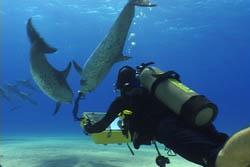
Sunday 8-3.We cruise during the day near Bimini looking for spotted dolphins in a place I’ve been coming since 1989. Late in the day we find them. Swimmers fly off the side of the boat and soon find themselves among the most up close and personal dolphins I’ve ever encountered. They cruise by, half closing their eyes as they go into interlock with one swimmer or another. This is made possible because we approach the dolphins slowly. Of course we can only be with them if they want to be with us. With this approach one dolphin may fix it’s eyes on a diver and if the diver looks back and maintains eye contact an interlock takes place not unlike two lovers.
The dolphin narrows its eyes and appears in a state of ecstasy and if the diver will swim calmly alongside the dolphin a connection forms that is deeply moving. Several swimmers exit the water amazed, those who have had previous experience with dolphins perhaps more so than neophytes. This has been an extraordinarily intimate encounter that lasted more than an hour.
You really have to think what it means that we can come out to these remote areas of the Bahamas and find friendly, curious dolphins who clearly enjoy their encounters with us and much as we do with them. These creatures are in no way lower than we are in intelligence and sentience or right to live. That knowledge gives rise to a whole new morality that includes the needs and wellbeing of animals.
Mon. 8-4. The second day we find a small group of bottlenose skimming along the bottom searching for small fish like flounders and pearly razors. Nurse sharks are feeding nearby. I can’t see any connection between the dolphin’s activities and the nurse sharks.
Tues 8-5. Early morning. Spotted dolphins. Again very close interactions with our swimmers. We then proceed south along the Bimini chain finding wonderful shallow water snorkeling spots. There is a huge variety of life on what appear to be health reefs. Mustard coral colors the reef in the shallow sunny waters. In the crevices are small octopus, moray eels and myriad fish of brilliant color.
It has been my desire to find friendly or accessible schools of dolphins around the world. My first encounters with friendlies came in 1978 north of Grand Bahama when I met a school of spotted dolphins about whom I made a number of films, most recently The Dolphin Defender on PBS, and whom we continue to visit to this day. I’ve found and swum with friendly bottlenose in Rangiroa, with killer whales in Norway and with sperm whales in both the Galapagos and off Dominica.
In 1989, on a tip from treasure diver Bob Marx led me to El Dorado Shoals off Bimini to find another school of friendly dolphins. And now we are heading even further south in the Biminis to find still another school of spotted dolphins we hope will be at least approachable.
Wed 8-6. OCay. This is our first visit to the area and I didn’t want to disappoint our associates who had already been having great encounters at Bimini. I felt real pressure to find dolphins down here. And we did - as many as 30 spotters. They were accessible but did not display the friendliness of the Bimini group. Because the dolphins were approachable but not friendly this developed into an excellent opportunity to look at their behavior. The water is extraordinarily clear and we could see the spotted dolphins plunging their noses into the sand in search of small prey. There were many juveniles in the group and I could see the “crèche” formation where adults are outriders to the calves they try to contain in the middle. Of course the calves test the limits constantly rocketing out of the circle to check on what manner of bizarre creature has entered their space. “Hmm. Very awkward these featherless bi-peds! But they seem to breathe air like us so they’re not fish.”
Thur. 8-7. We encountered spotted dolphins in the morning in very murky water. There was a group of five juveniles – still no development of spots – who charged around us when we were in the water. Their energy was enormous. They looked us in the eye but it was in “fly by” mode.
The weather has been extraordinary. The Bahamas tend to be very calm during August and your major risk is a hurricane. But nothing came across the Atlantic to spoil our party this year.
Just before leaving the shallow sand banks where we usually encounter the dolphins everyone goes overboard for a last swim. The water is thirty feet deep and astonishingly clear. An odd but wonderful sight - all of us floating in the ocean miles from land laughing and talking about the wondrous experience we’ve just had.
I return to home in St. Augustine to learn that my film “The Dolphin Defender” will be playing on NATURE on PBS Sunday night. From the first friendly meeting with dolphins in 1978 I have known a deep sense of privilege and corresponding duty to protect dolphins to the best of my ability. I cannot simply enjoy their company in the Bahamas and ignore their plight elsewhere.
Wednesday, November 21, 2007
Why Taiji, Japan Fishermen Kill Dolphins
By Hardy Jones
Taiji, Japan, Nov 8, 2007
We all search for reasons why the fishermen at Taiji continue to hunt dolphins despite massive international protest and revulsion, and despite the fact that the name of Japan is besmirched by allowing such atrocities.
There are several reasons. One is that the dolphin fishermen make good money doing this, especially from selling the live dolphins they capture. The second is that the Japan Fisheries Agency never retreats, never surrenders any resource. This is the same agency that has said they will allow the Japanese Antarctic Whaling Fleet to hunt Humpback Whales this December. They thumb their nose at the world (actually it’s the middle finger they use).
The third is that those who carry out or give permission for these heinous slaughters simply lack empathy for dolphins. They do not project themselves into the skin and minds of the animals they grab from the sea, confine in nets and then slaughter in front of their families without the slightest care for their pain. Perhaps it is a simple lack of imagination.
Or perhaps their financial self-interest simply governs where they will allow themselves to experience empathy.
If they would suddenly realize that dolphins are sentient, loving, socially close, highly intelligent animals, who probably experience the world pretty much as they do, they would have to quit their dolphin killing business. They would lose money and they would have to admit to themselves the unspeakable pain they have caused. They would have to admit that they are mass murderers.
Taiji, Japan, Nov 8, 2007
We all search for reasons why the fishermen at Taiji continue to hunt dolphins despite massive international protest and revulsion, and despite the fact that the name of Japan is besmirched by allowing such atrocities.
There are several reasons. One is that the dolphin fishermen make good money doing this, especially from selling the live dolphins they capture. The second is that the Japan Fisheries Agency never retreats, never surrenders any resource. This is the same agency that has said they will allow the Japanese Antarctic Whaling Fleet to hunt Humpback Whales this December. They thumb their nose at the world (actually it’s the middle finger they use).
The third is that those who carry out or give permission for these heinous slaughters simply lack empathy for dolphins. They do not project themselves into the skin and minds of the animals they grab from the sea, confine in nets and then slaughter in front of their families without the slightest care for their pain. Perhaps it is a simple lack of imagination.
Or perhaps their financial self-interest simply governs where they will allow themselves to experience empathy.
If they would suddenly realize that dolphins are sentient, loving, socially close, highly intelligent animals, who probably experience the world pretty much as they do, they would have to quit their dolphin killing business. They would lose money and they would have to admit to themselves the unspeakable pain they have caused. They would have to admit that they are mass murderers.
Taiji Dolphin Slaughter Draws World-wide Condemnation
By Hardy Jones
Taiji, Japan Nov. 6, 2007
SEE VIDEO OF SLAUGHTER OF RISSOS DOLPHINS AT BOTTOM OF THIS PAGE. Warning, it is highly graphic.
“This place is now a battlefield,” is how a police inspector assessed the current situation here in Taiji, Japan.
To my mind this is a huge exaggeration but shows the mind set of the people who live in this beautiful, remote and extremely quiet coastal village where local fishermen routinely capture and kill thousands of dolphins.
The dolphin hunters have been stunned by the appearance of wave after wave of filmmakers, environmentally concerned surfers, Hollywood celebs and journalists. On Monday, October 30 they had corralled some thirty pilot whales in the killing bay. As they began their grizzly slaughter 38 surfers paddled into the picture. Cameras rolled and then a remote controlled helicopter flew over bearing a small camera that recorded the butchery. The footage was soon appearing on TV and computer screens around the world.
The fishermen were apoplectic. What they fear and detest most is public exposure and here it is in spades.
For years BlueVoice operated in Taiji alone. Our documentaries appeared on National Geographic and PBS and caused avalanches of protest generated through the BV web site. The fishermen hate us and consistently tried to wrest our video from us. But they were powerless to stop us. Over the years others have joined the fight to save the dolphins here. They are welcome to the fight.
I received a very nice note from one of the surfers who had participated in this demonstration of support for the dolphins:
hi hardy having part of the surf crew into Taiji i appreciate even more the great work you have being doing all these years and we will be sure to put bluevoice out to people. with thanks, howie surfersforcetaceans.org
But this year a critical mass seems to have been reached. Just as the surfers were escorted out of town for crossing the dolphin hunters nets, BlueVoice arrived. The dolphin hunters have not ventured out since we appeared – seven days with no dolphin hunting.
My notion is that the fishermen are reeling. I think they have always imagined that interest in this abomination would melt away. But the reverse is happening. Each time word about the tragic and brutal killings here reaches the world more attention is attracted.
The combination of television and internet exposure of the dolphin slaughter here and mounting evidence of the toxicity of the dolphin meat ought to bring an end to this savagery. BlueVoice will soon publish the results of tests of both dolphin meat and fish caught in the Taiji area. Early results show the dolphin meat is contaminated by both mercury and organic pollutants at levels far exceeding Japanese health standards.
Exposing Toxic Levels in Dolphin Meat Key to Ending Slaughters. bluevoice.org/sections/ocean/doltoxin.shtml
Taiji, Japan Nov. 6, 2007
SEE VIDEO OF SLAUGHTER OF RISSOS DOLPHINS AT BOTTOM OF THIS PAGE. Warning, it is highly graphic.
“This place is now a battlefield,” is how a police inspector assessed the current situation here in Taiji, Japan.
To my mind this is a huge exaggeration but shows the mind set of the people who live in this beautiful, remote and extremely quiet coastal village where local fishermen routinely capture and kill thousands of dolphins.
The dolphin hunters have been stunned by the appearance of wave after wave of filmmakers, environmentally concerned surfers, Hollywood celebs and journalists. On Monday, October 30 they had corralled some thirty pilot whales in the killing bay. As they began their grizzly slaughter 38 surfers paddled into the picture. Cameras rolled and then a remote controlled helicopter flew over bearing a small camera that recorded the butchery. The footage was soon appearing on TV and computer screens around the world.
The fishermen were apoplectic. What they fear and detest most is public exposure and here it is in spades.
For years BlueVoice operated in Taiji alone. Our documentaries appeared on National Geographic and PBS and caused avalanches of protest generated through the BV web site. The fishermen hate us and consistently tried to wrest our video from us. But they were powerless to stop us. Over the years others have joined the fight to save the dolphins here. They are welcome to the fight.
I received a very nice note from one of the surfers who had participated in this demonstration of support for the dolphins:
hi hardy having part of the surf crew into Taiji i appreciate even more the great work you have being doing all these years and we will be sure to put bluevoice out to people. with thanks, howie surfersforcetaceans.org
But this year a critical mass seems to have been reached. Just as the surfers were escorted out of town for crossing the dolphin hunters nets, BlueVoice arrived. The dolphin hunters have not ventured out since we appeared – seven days with no dolphin hunting.
My notion is that the fishermen are reeling. I think they have always imagined that interest in this abomination would melt away. But the reverse is happening. Each time word about the tragic and brutal killings here reaches the world more attention is attracted.
The combination of television and internet exposure of the dolphin slaughter here and mounting evidence of the toxicity of the dolphin meat ought to bring an end to this savagery. BlueVoice will soon publish the results of tests of both dolphin meat and fish caught in the Taiji area. Early results show the dolphin meat is contaminated by both mercury and organic pollutants at levels far exceeding Japanese health standards.
Exposing Toxic Levels in Dolphin Meat Key to Ending Slaughters. bluevoice.org/sections/ocean/doltoxin.shtml
Exposing Toxic Levels in Dolphin Meat Key to Ending Slaughters
By Hardy Jones
Taiji, Japan Nov. 5, 2007
I’m reporting today from Taiji, Japan, a village I first visited in 1980 when we were able to rescue some 200 false killer whales from butchery.
For nearly three decades I’ve fought to end the slaughter of dolphins in Japan. Filming these unspeakably cruel butcherings and distributing the footage to news media around the world has brought huge embarrassment to Japan. I have placed this footage in four documentaries which have been seen in excess of 100-million people and tens, if not hundreds of thousands of emails and faxes of protest have arrived on the desks of Japanese officials as a result.
Virtually all villages that hunted dolphins have quit doing it. Part of that is international pressure brought about by television and internet exposes of these dolphin atrocities.
Taiji still holds out as the die-hard village that insists that their culture depends upon hunting whales and dolphins.
But the whole equation has changed. The death of dolphin hunting here will come about because revelations of the high toxic levels in the dolphin meat are finally striking home. Levels of mercury and chemicals such as PCBs in samples of dolphin meat taken from local super markets vastly exceed safe levels. But the Japanese government is not enforcing their own laws (which makes you wonder how much we can trust food imports from Japan).
For Japanese content click http://bluevoice.org/sections/dolphins/save_jp.shtml
For interview in Japanese with Japanese mercury expert click http://bluevoice.org/sections/ocean/doltoxin.shtml
For more information on toxics click http://bluevoice.org/toxic_lv2.shtml
But local supermarkets and some market chains have taken dolphin meat off the shelves. Dolphin meat provided by the dolphin killers to schools has now been refused. Overall the demand for whale and dolphin meat is dropping and so is the price.
Progress is slow but it is certain.
Taiji, Japan Nov. 5, 2007
I’m reporting today from Taiji, Japan, a village I first visited in 1980 when we were able to rescue some 200 false killer whales from butchery.
For nearly three decades I’ve fought to end the slaughter of dolphins in Japan. Filming these unspeakably cruel butcherings and distributing the footage to news media around the world has brought huge embarrassment to Japan. I have placed this footage in four documentaries which have been seen in excess of 100-million people and tens, if not hundreds of thousands of emails and faxes of protest have arrived on the desks of Japanese officials as a result.
Virtually all villages that hunted dolphins have quit doing it. Part of that is international pressure brought about by television and internet exposes of these dolphin atrocities.
Taiji still holds out as the die-hard village that insists that their culture depends upon hunting whales and dolphins.
But the whole equation has changed. The death of dolphin hunting here will come about because revelations of the high toxic levels in the dolphin meat are finally striking home. Levels of mercury and chemicals such as PCBs in samples of dolphin meat taken from local super markets vastly exceed safe levels. But the Japanese government is not enforcing their own laws (which makes you wonder how much we can trust food imports from Japan).
For Japanese content click http://bluevoice.org/sections/dolphins/save_jp.shtml
For interview in Japanese with Japanese mercury expert click http://bluevoice.org/sections/ocean/doltoxin.shtml
For more information on toxics click http://bluevoice.org/toxic_lv2.shtml
But local supermarkets and some market chains have taken dolphin meat off the shelves. Dolphin meat provided by the dolphin killers to schools has now been refused. Overall the demand for whale and dolphin meat is dropping and so is the price.
Progress is slow but it is certain.
Taiji, Japan Councilman Opposes Mercury in School Lunches
Nov 1, 2007
by Hardy Jones
If you want a hero, I’ve got one for you. My colleague, Sakae Hemmi of Elsa Nature Conservancy, and I interviewed this humble but extraordinary man for two hours yesterday - a man who has virtually written off his political career by simply pointing out that the local school district was feeding mercury-laden dolphin meat to school children.
Taiji is the last holdout among villages regularly hunting dolphins off the Japanese main island. Its people do not want their dirty laundry aired outside of Taiji. It’s understandable – there’s plenty of filth. But Mr. Junichiro Yamashita, an Assemblyman in Taiji, Wakayama Prefecture, is the first official to come out and take a stand against the utterly idiotic practice of poisoning school children in their formative years with methyl mercury at a time when they are most susceptible to learning disability and neurological problems.
He called the meat served to the students exactly what it is - “toxic waste” - and that is not exaggeration. He has had pilot whale meat obtained in Taiji tested for mercury and PCBs and found the levels shockingly high.
He has had the courage to go before the international press and tell this sordid story of dolphin hunters trying to create a new market for their contaminated goods. And he has his own blog, written in Japanese. The local people hate this.
Mr. Yamashita was told he would not win reelection if he spoke of the dolphin issue. He and his wife have been socially ostracized. She is very disappointed about this but totally supports her husband’s work.
Yamashita-san is a formidable man. He has a huge collection of data on toxic chemicals in the marine environment and how it affects human beings. He uses the internet with great facility over ADSL. This is not the last we will hear from this highly intelligent and dedicated man.
What he has done is put the community’s interests ahead of his own. He has gone out of his way to make things better – something politicians, something all of us could practice more.
by Hardy Jones
If you want a hero, I’ve got one for you. My colleague, Sakae Hemmi of Elsa Nature Conservancy, and I interviewed this humble but extraordinary man for two hours yesterday - a man who has virtually written off his political career by simply pointing out that the local school district was feeding mercury-laden dolphin meat to school children.
Taiji is the last holdout among villages regularly hunting dolphins off the Japanese main island. Its people do not want their dirty laundry aired outside of Taiji. It’s understandable – there’s plenty of filth. But Mr. Junichiro Yamashita, an Assemblyman in Taiji, Wakayama Prefecture, is the first official to come out and take a stand against the utterly idiotic practice of poisoning school children in their formative years with methyl mercury at a time when they are most susceptible to learning disability and neurological problems.
He called the meat served to the students exactly what it is - “toxic waste” - and that is not exaggeration. He has had pilot whale meat obtained in Taiji tested for mercury and PCBs and found the levels shockingly high.
He has had the courage to go before the international press and tell this sordid story of dolphin hunters trying to create a new market for their contaminated goods. And he has his own blog, written in Japanese. The local people hate this.
Mr. Yamashita was told he would not win reelection if he spoke of the dolphin issue. He and his wife have been socially ostracized. She is very disappointed about this but totally supports her husband’s work.
Yamashita-san is a formidable man. He has a huge collection of data on toxic chemicals in the marine environment and how it affects human beings. He uses the internet with great facility over ADSL. This is not the last we will hear from this highly intelligent and dedicated man.
What he has done is put the community’s interests ahead of his own. He has gone out of his way to make things better – something politicians, something all of us could practice more.
Subscribe to:
Comments (Atom)