The International Myeloma Foundation (IMF) has published a report that describes a genetic link between environmental toxins and bone disease in multiple myeloma, a form of blood/bone cancer. Once considered a disease of the elderly, and a rare one at that, myeloma is increasingly being diagnose in patients under 45. The big question is "why, when many cancers are being reduced in incidence, is myeloma increasing and penetrating lower age groups?
One possible explanation is the increase in environmental toxins. But what is the connection between the toxins and the disease?
Researchers with the IMF gene bank (Bank on a Cure) have identified changes in SNPs (single nucleotide polymorphisms) that are part of DNA sequences. These changes reduce a person's ability to process chemical toxins such as Dioxin and may lead to cancer.
The finding, published in the latest issue of the journal Leukemia, authored by Dr. Brian Durie, chair of the IMF, - http://www.myeloma.org - provide a possible link between myeloma and environmental toxins.
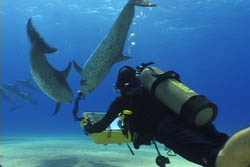
As these toxins rise in the marine food chain we are seeing more cases of cancer in dolphins, types of cancer never before identified in these marine mammals. Dolphins should be seen as sentinels warming us to the dangerous levels of pollution accumulating in our oceans.
If we analyse the status of disease and pollution in dolphins worldwide we can conclude only that a global pandemic exists that now threatens dolphins and more and more is a menace to human health.
Hardy Jones
Showing posts with label pollution. Show all posts
Showing posts with label pollution. Show all posts
Monday, August 17, 2009


Monday, August 3, 2009
Scientists Study Massive Debris in Pacific
Marine scientists from Scripps Institute of Oceanography are en route to the middle of the North Pacific for a study of plastic debris accumulating across hundreds of square miles of sea north of the Hawaiian Islands called the "Great Pacific Garbage Patch."
The expedition will study how much debris is collecting in what is known as the North Pacific Ocean Gyre, and how that material - mostly tiny plastic fragments - affects marine life.
The debris is concentrated by circular ocean currents within a vast "convergence zone" roughly midway between Japan and the West Coast of the United States.
"The concern is what kind of impact those plastic bits are having on the small critters on the low end of the ocean food chain," Bob Knox, deputy director of research at Scripps, said after the ship had spent its first full day at sea.
Besides the potential harm to sea life caused by ingesting bits of plastic, the expedition team will look at whether the particles could carry other pollutants.
Subscribe to:
Posts (Atom)