At the end of my last post our party had been marooned on the shore of Lake Tanganyika when the boat Goodall sent for us broke down just off a desolate village. Our two Africa boatmen loped off back toward Kigoma.
Nat, Julia and I sat there speechless. Things were about to get worse.
A band of six or seven African men approached us smiling big. Lots of white teeth. They were drunk and they had guns. The only positive development was that they spoke French. It turned out they were rebels who had been driven out of Congo across the Lake to the west.
We were all truly afraid for our lives. One guy, brain sloshed in alcohol, could decide to blow us away for fun. We’d disappear and no one would know it had ever happened.
I decided it would be best if we walked into the village. I actually felt hungry. It’s impossible to convey the poverty of this village. People just sat around with blank stares on their faces in front of their miserable huts. Then we spotted a dented and rusty sign with a Pepsi logo and the words “New Yankee Restaurant.” Huh!
We entered the dark premises and saw a fire at the back. A frail elderly man hunched over a paint can filled with oil set over an open fire. We made motions of our hands to our mouths – the international signal for eat and he waved us to a log used as a seat. He then raised his index finger while raising his eyebrows. You want one? Then alternated the one finger with the middle finger to indicate “Or two?”
One or two of what we wondered. Not knowing what was on offer we signaled “one” and waited to see the fare. The old man reached into a tin, pulled out some dough, wadded it into the size of a baseball and threw it into the oil in the paint can. Two minutes later he plucked the sizzling blob out of the oil and threw it down on a tin plate. It was muddy brown. The room was so dark it was impossible to ascertain the cleanliness of the plate but there was a decidedly hard and heavy sound to the impact on the plate of what I was beginning to think of as a kind of donut.
Whatever it might have been it was way too hot to eat so we were left to ponder who, if any of us, would allow hunger to overcome aversion.
When the cook motioned toward the “donut” I suspended rational process and reached down and tried to pinch a small portion out of the blob only to discover it was more a rock than a blob. Eventually I was able to break off a small portion and, with both Julia and Nat watching, put it in my mouth.
It was totally saturated in oil which, while rancid, at least didn’t taste like it was petroleum based. There was no other taste to it.
We extricated ourselves from the New Yankee Restaurant by paying what was surely far more than we should have and signaling we wanted to eat it while walking along the shore of the lake.
For another hour we sat near our boat and pondered our situation. There is no doubt this was one of the most dangerous situations I’d ever been in. The drunken men with automatic weapons followed us around, occasionally inviting us somewhere or other. I was concerned that Julia, being a woman, might be in more danger than the rest of us.
At dusk the sound of an outboard motor reached our ears and to our immense relief a small skiff appeared, driven by the boatmen who had set off for Kigoma five hours previously.
We took the original boat in tow and headed north along the eastern shore of the lake resuming our voyage to the Goodall camp. It was after dark when we turned into the shore and beached both boats. Dr. Goodall emerged onto the rocky shoreline with a flashlight. We began to unload our gear, taking care not to step into the water.
Her first question was “what kind of food did you bring.” I realized instantly that we had made a big mistake not doing some shopping at Kigoma.
“We landed late and weren’t able to get anything.”
She expressed mild irritation and said “well we don’t have any food here.” It had never really occurred to me that you could get to a place where there actually was no food. She was somewhat mollified when I told her we did have her engine parts, T-shirts and floppy hats.
Eventually we stashed all our gear and sat down at a small table in her cottage. Momentarily a sweet potato appeared which we all divided. That was it for food.
Hunger kept me awake and alert far longer than I normally would have been. I explained to her how we approached dolphins in the wild. She was interested in the fact that dolphins maintained eye contact with us. It’s very poor etiquette to look directly at male silverback gorilla and might easily earn you a charge. Among chimps eye contact is broken during periods of conflict and reestablished during reconciliation.
I described our methods of naming individual dolphins and how we had foolishly named a young dolphin One Spot, only to find the following year that One Spot had become Four Spot a product of maturation in all spotted dolphins.
I was humbled to be in Dr. Goodall’s presence and delighted that she didn’t laugh me out of the room as I described our work in the Bahamas. On the contrary she summed up her feelings saying “what you are doing is analogous to what we’re doing here. One of the main benefits of your work is to make the dolphins real for people, to make people empathize with the dolphins and feel what they feel. People will protect only those things they love and your films certainly make people fall in love with those dolphins.”
Eventually exhaustion overcame adrenalin and we all drifted off to our sleeping bags.
In the morning we awakened and prepared for our trek up the hillside to where she expected we’d find one of the bands of chimps she had been working with for 27 years.
There was tea but the question of a heartier breakfast didn’t come up so I asked Dr. Goodall if I might have a banana off the large stalk resting near the front door.
“Those are for the chimps . . . but you can have one,” she replied, underlining the word “one”.
I felt so maladroit and wanted to explain that we were ocean and boat people – not Africa bush people. Our meals at sea were always served on demand and in great abundance. But I knew we’d flubbed it when we didn’t bring our own food.
The weather was equatorially hot and I sweated immediately through my khaki shirt as Nat, Julia and I climbed the hill. Occasionally Jane (she’d suggested we drop the Dr. bit and call her by her first name) would stop and point out a location where she’s first met a certain chimp or from which she had observed the troops before making close encounters. The combination of no food and dehydration lent the whole experience a not unpleasant hallucinogenic feel.
Near the top of the hill Jane led us to a cement block hut with a door consisting of stout iron bars. She explained that when she had her young son, whom she referred to as Grub, with her she’d had to lock him in the hut for fear that he would be kidnapped by the chimps. She also told us that Grub had come down with Schistosomiasis and that, while he was now well, might not have fully rid himself of the parasite. Give me sharks any day.
We put our gear into the hut along with the huge stalk of bananas. As we exited she threw the bolt and warned us “never leave this door open – even for an instant.” We nodded okay not bothering to ask why.
I set up my camera on a tripod and Julia got the recording devices ready and mic’d Jane. It was not long before a chimp sauntered into the clearing. He walked right up to Goodall and extended his hand, his long index finger looking like the model for the ceiling of the Cistine Chapel. Other chimps appeared on the periphery and baboons appeared scuttling around looking very deferential to the chimps. WE were aqbout to meet the most famous chimps in the world.
To be continued . . .The Great Banana Heist
For more stories of interspecies contacts in many oceans of the world read The Voice of the Dolphins by Hardy Jones, available in print and Kindle at Amazon.com
Showing posts with label Goodall. Show all posts
Showing posts with label Goodall. Show all posts
Saturday, August 13, 2011


Friday, August 5, 2011
Metting Goodall: Of Dolphins and Chimps
by Hardy Jones
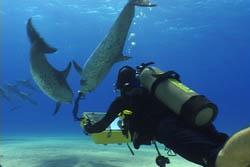
When I realized that our initial contacts with the spotted dolphins in the Bahamas were not a one-time event, it became clear there was an extraordinary opportunity to study a group of highly intelligent animals in the wild.
There was an obvious comparison between the work we were doing and the groundbreaking efforts of Dr. Jane Goodall at Gombe Stream Reserve in Tanzania. We had hoped to have her join us in the Bahamas but when that wasn’t possible my work on a PBS special in 1087 gave me the opportunity to visit her at her worksite on Lake Tanganyika.
The trip was not an easy one. Julia Whitty, Nat Katzman (a producer from PBS)) and I went through Nairobi on the way to Dar Es Salaam, Tanzania. We stayed at the legendary Norfolk Hotel, had magnificent breakfasts every morning and sortied out to various national parks to cover stories about people who were making a difference in the protection of wildlife in Kenya for our film “Saving the Wildlife”.
When we returned to the Norfolk one evening we found a letter under our door from Dr. Goodall asking us to bring a few things with us when we flew to meet her in Tanganyika. The request included motor parts, some T-shirts and hats. We wondered why she didn’t just get them in Dar Es Salaam but purchased and packed them for the flight.
After arrival in Dar Es Salaam we soon learned the reason for her request – the city had absolutely nothing available to buy. Nothing. No thing. The socialist regime of Julius Nyerere had absolutely ruined the economy. Small shops were open but had nothing to sell. When we sat down to breakfast there was a full menu. We ordered and the waiter dutifully noted our requests. And then nothing came. All we could get was tea and stale bread.
We flew in a twin-engine charter plane from Dar to Kigoma, on the eastern shore of Lake Tanganyika close to the border with Burundi. There we were met by a small skiff powered by a single outboard motor and operated by two young African men who did not speak English. The vessel, sent by Dr. Goodall, was covered by a wooden roof held up by four two-by-twos.
Dr. Goodall had advised us to buy our own food in Kigoma to bring to her home site. We went to the market but the fruits, vegetables and meat were so covered with flies that we defaulted to “well, she’s got to have something better than this.”
Lake Tanganyika is the longest fresh water lake in the world measuring 675 kilometres north to south and is 500 feet deep in some areas, making it the second deepest lake in the world. We motored along the shore for a couple of hours appalled by endless hillsides absolutely denuded of trees. In some places the hills were gouged by runoff and the soil showed bright rust in color. In other areas the slopes were great burnt swaths. It was sickening.
A southerly wind pushed up some fairly good swells that helped our ramshackle vessel along at a good clip. We were starting to relax when the motor quit a hundred yards off a small village. We started drifting toward shore. The conversation turned to the highly poisonous water cobras common in the lake and the danger of exposure to the parasite Schistosomiasis. We weren’t sure but we’d heard that the parasitic worms or flukes could enter the urethra and make their way to the bladder. None of us were going to enter the water.
After 45 minutes the boat washed ashore on a beach just south of the village. The two young African men informed us by signs that they would run back to Kigoma to get a replacement part.
As we sat down on the beach a group of drunken men carrying assault rifles approached us. The had come from the civil war in the Congo just across the lake.
To be continued.
When I realized that our initial contacts with the spotted dolphins in the Bahamas were not a one-time event, it became clear there was an extraordinary opportunity to study a group of highly intelligent animals in the wild.
There was an obvious comparison between the work we were doing and the groundbreaking efforts of Dr. Jane Goodall at Gombe Stream Reserve in Tanzania. We had hoped to have her join us in the Bahamas but when that wasn’t possible my work on a PBS special in 1087 gave me the opportunity to visit her at her worksite on Lake Tanganyika.
The trip was not an easy one. Julia Whitty, Nat Katzman (a producer from PBS)) and I went through Nairobi on the way to Dar Es Salaam, Tanzania. We stayed at the legendary Norfolk Hotel, had magnificent breakfasts every morning and sortied out to various national parks to cover stories about people who were making a difference in the protection of wildlife in Kenya for our film “Saving the Wildlife”.
When we returned to the Norfolk one evening we found a letter under our door from Dr. Goodall asking us to bring a few things with us when we flew to meet her in Tanganyika. The request included motor parts, some T-shirts and hats. We wondered why she didn’t just get them in Dar Es Salaam but purchased and packed them for the flight.
After arrival in Dar Es Salaam we soon learned the reason for her request – the city had absolutely nothing available to buy. Nothing. No thing. The socialist regime of Julius Nyerere had absolutely ruined the economy. Small shops were open but had nothing to sell. When we sat down to breakfast there was a full menu. We ordered and the waiter dutifully noted our requests. And then nothing came. All we could get was tea and stale bread.
We flew in a twin-engine charter plane from Dar to Kigoma, on the eastern shore of Lake Tanganyika close to the border with Burundi. There we were met by a small skiff powered by a single outboard motor and operated by two young African men who did not speak English. The vessel, sent by Dr. Goodall, was covered by a wooden roof held up by four two-by-twos.
Dr. Goodall had advised us to buy our own food in Kigoma to bring to her home site. We went to the market but the fruits, vegetables and meat were so covered with flies that we defaulted to “well, she’s got to have something better than this.”
Lake Tanganyika is the longest fresh water lake in the world measuring 675 kilometres north to south and is 500 feet deep in some areas, making it the second deepest lake in the world. We motored along the shore for a couple of hours appalled by endless hillsides absolutely denuded of trees. In some places the hills were gouged by runoff and the soil showed bright rust in color. In other areas the slopes were great burnt swaths. It was sickening.
A southerly wind pushed up some fairly good swells that helped our ramshackle vessel along at a good clip. We were starting to relax when the motor quit a hundred yards off a small village. We started drifting toward shore. The conversation turned to the highly poisonous water cobras common in the lake and the danger of exposure to the parasite Schistosomiasis. We weren’t sure but we’d heard that the parasitic worms or flukes could enter the urethra and make their way to the bladder. None of us were going to enter the water.
After 45 minutes the boat washed ashore on a beach just south of the village. The two young African men informed us by signs that they would run back to Kigoma to get a replacement part.
As we sat down on the beach a group of drunken men carrying assault rifles approached us. The had come from the civil war in the Congo just across the lake.
To be continued.
Subscribe to:
Posts (Atom)